
The History of Persian Rugs: From the Pazyryk Carpet to the Safavid Golden Age
Oriental Rug Works
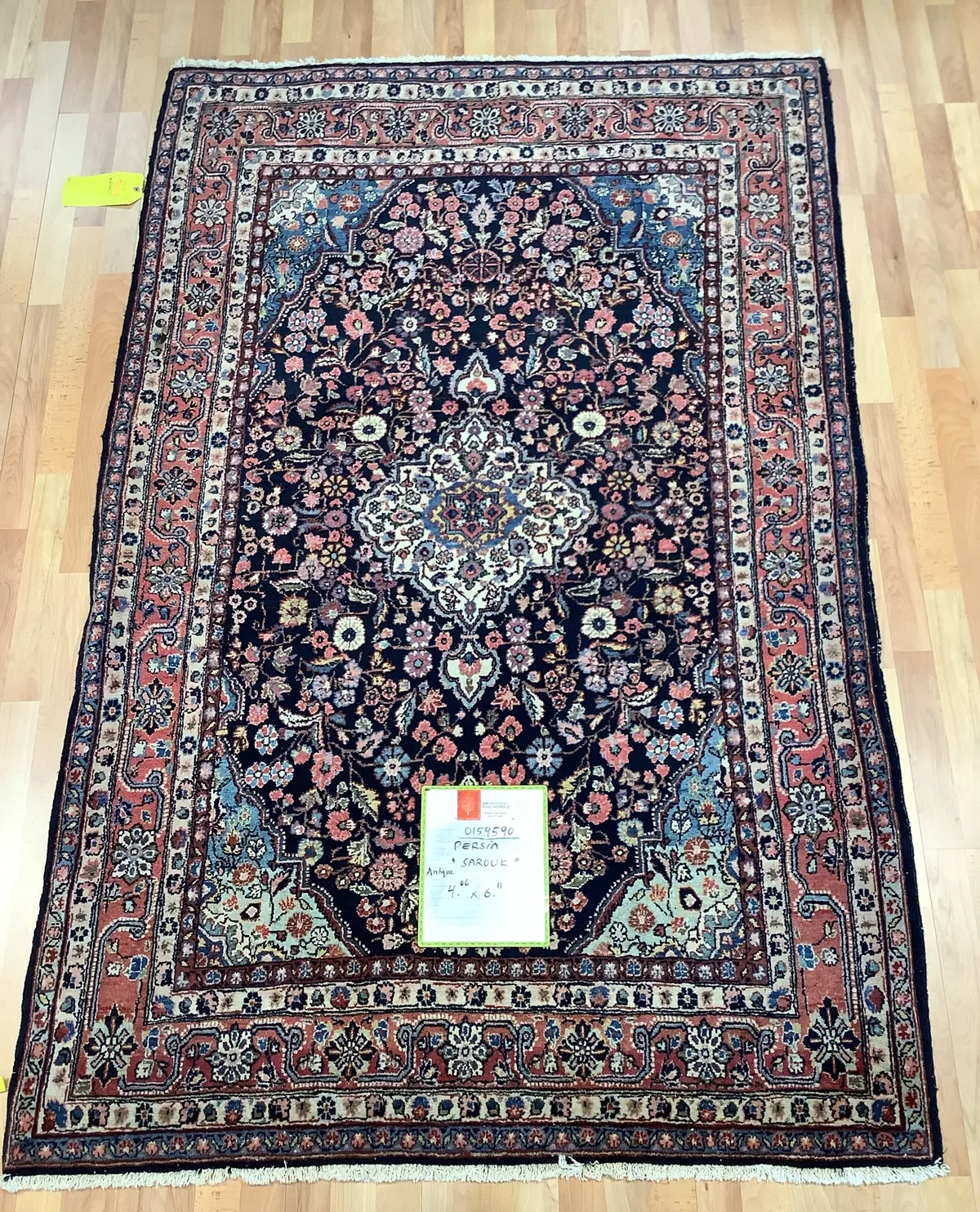
Run your hand across a hand-knotted Persian rug and you're touching one of the oldest luxury traditions in the world. Here's how a story more than two thousand years in the making unfolds, from the Pazyryk carpet to the Safavid golden age.
Run your hand across a hand-knotted Persian rug and you're touching one of the oldest luxury traditions in the world. Every knot was tied by hand, one at a time, in a craft that shahs commissioned, merchants carried across continents, and great museums now protect behind glass.
That's the quiet thrill of owning one: a Persian rug is a piece of a story more than two thousand years in the making. Here's how it unfolds.
The oldest pile carpet in the world
In 1949, Russian archaeologist Sergei Rudenko excavated a burial mound at Pazyryk, in the Altai Mountains of southern Siberia. Ice had sealed the tomb, preserving something extraordinary: a wool pile carpet about 6 by 6½ feet, dated to the 5th to 4th century BC.
The Pazyryk carpet is the oldest knotted pile carpet known. Its center holds 24 cross-shaped figures built from stylized lotus buds, framed by borders of griffins, fallow deer, and men on horseback. It's tied with symmetrical knots, and today it's kept at the State Hermitage Museum in St. Petersburg.
Where it was woven is still debated; the Hermitage notes theories pointing to Iran and to Central Asia. Either way, it proves something remarkable: about 2,400 years ago, knotted pile weaving was already a mature, sophisticated art.
From illuminated books to medallion carpets
Surprisingly little is known about Persian carpet making in the centuries that followed. By the 1400s, though, the art was approaching a peak, and one of the most recognizable layouts in rug design took shape. Designers borrowed from the illuminated pages and bindings of Persian books: a grand central medallion, with quarter medallions echoing it in the corners. If your rug has a medallion at its heart, it carries an idea borrowed from the illuminated manuscripts of 15th-century Persia.
The Safavid golden age
The Safavid dynasty ruled Iran from 1501 to 1722, and under its patronage Persian carpets reached heights that many experts still consider the summit of the art.
The most famous example is the Ardabil Carpet, made for the shrine of Shaykh Safi al-Din at Ardabil, ancestor of the dynasty's founder. An inscription woven into one end gives the date 946 in the Islamic calendar (1539–40 AD) and the name Maqsud Kashani. The V&A in London, which acquired it in 1893, calls it the world's oldest dated carpet. Its colors came from natural sources such as pomegranate rind and indigo, and when the designer William Morris inspected it for the museum, he praised its "singular perfection."
Then came Shah Abbas I (reigned 1587–1629), who moved his capital to Isfahan and set up royal workshops for textiles and carpets. As the Metropolitan Museum of Art puts it, carpet weaving was transformed from a craft practiced by nomads and villagers into a national industry, with designs drafted by professional artists. Persian carpets traveled to Europe as status symbols, often too precious for the floor, spread over tables or hung on walls instead.
The court workshops also produced dazzling silk carpets woven with gold and silver thread. When some of these were shown at the 1878 Paris exposition, they were mistaken for Polish work. That's why they're still called "Polonaise" carpets today.
Villages and tribes kept the tradition alive
Court carpets get the headlines, but they were never the whole story. Nomads and town weavers across Persia kept weaving with dyes and designs passed down through generations. In western Iran, the district around Sultanabad (today's Arak) became famous for its rugs, including the Sarouk, with its classic medallion designs.
The 19th-century revival, and how Persian rugs came West
In the second half of the 1800s, demand from Europe and America surged. Merchants in Tabriz organized weaving for export, and Ziegler & Co., a Manchester-based trading firm, set up rug production in Sultanabad, adapting sizes and colors for Western homes.
By 1892, the British statesman George Curzon wrote that Persian carpets had become so celebrated that the upper-class householder in England or America rarely failed to see owning one as "an indispensable testimony both to culture and to civilisation." The rug as a sign of taste is not a modern marketing idea. It's a reputation these rugs earned more than a century ago.
Persian rug history at a glance
| When | What happened |
|---|---|
| 5th–4th century BC | The Pazyryk carpet, the oldest known knotted pile carpet, is woven |
| 1400s | Medallion layouts borrowed from illuminated Persian books take shape |
| 1501–1722 | The Safavid dynasty rules Iran, the golden age of Persian carpets |
| 1539–40 | The Ardabil Carpet, the world's oldest dated carpet, is completed |
| 1587–1629 | Shah Abbas I sets up royal carpet workshops in Isfahan |
| Late 1800s | Export weaving grows in Tabriz and Sultanabad for Western homes |
| 1892 | George Curzon describes Persian carpets as a mark of culture in England and America |
Why this history matters when you choose a rug
When you choose a hand-knotted Persian rug, you're not just picking a pattern. You're joining a lineage. Because every knot is tied by hand, no two rugs are ever exactly alike. The names on a rug's tag, such as Tabriz, Kashan, Isfahan, and Sarouk, are real places with centuries of weaving behind them. The antique Persian Sarouk at the top of this page comes from that same Arak-region tradition.
That's why a fine rug changes a room the moment you walk in. It brings craftsmanship, history, and a story that's entirely its own.
Common questions
How old is the oldest Persian rug?
The oldest known knotted pile carpet, the Pazyryk carpet, dates to the 5th to 4th century BC, about 2,400 years ago. Where it was made is still debated; one theory is Iran. The oldest carpet with a woven date is the Ardabil Carpet of 1539–40, now at the V&A in London.
What made Safavid carpets so famous?
Royal patronage. Safavid shahs, above all Shah Abbas I, backed court workshops where professional artists drew the designs and skilled weavers worked in fine wool and silk, sometimes with gold and silver thread. The results became prized status symbols across Europe.
Why are they called Persian rugs?
"Persia" was the name most Westerners used for Iran until the 1930s. A Persian rug is one woven in Iran, and its trade name usually points to the city, village, or region where that style developed, such as Heriz, Tabriz, or Kashan.
Own a piece of the story
The best way to understand a Persian rug is to stand on one. Visit our shop at 109 Key Road in Keene, NH, take your time, feel the wool, and ask about the stories behind the names. Or browse our rugs online first and come see your favorites up close. Never any sales tax in New Hampshire! 🙌
Already have a family Persian rug? Our cleaning and repair services help keep it beautiful for the next generation.
- Call: (603) 357-8400 or (603) 357-5152
- Email: orientalrugworks@gmail.com
- Visit: 109 Key Road, Keene, NH 03431 (get directions)
- Hours: Monday–Friday 10–6, Saturday 10–5, closed Sunday
Questions before you visit? Send us a message.