
Salt Season Is Rug Season: How Winter Salt and Slush Damage Your Rugs — and What to Do Before Holiday Guests Arrive
Oriental Rug Works

The holidays bring the guests. Salt season brings the damage — and every boot that crosses your door carries it straight to your best rug. What salt does to wool, and the game plan that stops it.
The holidays bring the guests. Salt season brings the damage. From the first salt truck of the year until the last slushy week of March, every boot, paw, and grocery bag that crosses your doorway carries the same gritty brine — and the rug in your entryway is where it all ends up. Here is what that salt is actually doing to a fine wool rug, and the simple game plan that gets your home guest-ready without letting winter win.
What road salt does to a wool rug
Road salt is not just dirt, and that is why it is so hard on rugs. Two things happen at once:
- It is alkaline. Common de-icers — rock salt and the blended ice melts spread all over Keene — sit on the alkaline side of the scale. Left sitting in wool, that alkalinity can dull colors and stress the natural dyes that give a hand-knotted rug its depth.
- It is abrasive. Salt dries into sharp little crystals. Ground into the pile by foot traffic, those crystals work like fine sandpaper, cutting fibers a little more with every step.
- It holds moisture. Salt residue attracts dampness from the air, so a salted rug never quite dries out. The cotton foundation stays damp in a closed-up winter house, which is where musty smells begin.
As the slush dries, it leaves the calling card most people notice first: a pale, crusty white ring, and pile that feels stiff or crunchy underfoot.
Not all rugs take salt the same way
Wool is the best-case fiber for salt season — it is naturally resilient and can hide a surprising amount of grit in its pile — but that hidden grit is exactly the problem: a wool rug can look fine while crystals are sawing away at its foundation. Rugs with silk in the pattern are more delicate; silk fibers are less forgiving of alkaline residue and of the scrubbing people reach for when they see a white ring. Cotton-foundation rugs, which includes most hand-knotted pieces, suffer quietly in a different way — the foundation holds the damp brine longest, so it is the last part to dry and the first place a musty smell starts. And the machine-made synthetic rug by the door is not immune either: salt dulls it and grinds down its pile, it just costs less to lose. The fiber changes the timeline, not the routine.
The entryway problem: it gets ground in
A living-room rug sees a few passes a day. An entryway rug sees every arrival — family, guests, deliveries, the dog's four wet paws — all crossing the same three feet of pile. Each pass presses the grit deeper, past where a vacuum can reach, down toward the foundation. That is why entryway rugs age years faster than the identical rug in a quiet room, and why salt season is really an entryway story. For the winter-long routine that protects the rest of the house, see Winter in New Hampshire: Protecting Your Oriental Rug from Salt, Snow, and Slush.
Before the guests arrive: the game plan
About two weeks out — inspect and decide. Stand in the entry and really look: white rings that do not vacuum away, stiff or crunchy patches, a musty smell when you kneel down. Any of those means salt has reached the foundation, and home blotting will not fix it. That is the moment a professional wash earns its keep — it flushes the grit and brine out of the foundation instead of just cleaning the surface. See how oriental rug cleaning in Keene and area rug cleaning near Keene work, and remember pickup in Keene is free (other arrangements can be made), so the rug can be back underfoot before the doorbell starts ringing.
One week out — set up the defenses.
- Put a sturdy mat outside the door and a boot tray inside it. Most salt should die there, not on your rug.
- Rotate the entryway rug a half-turn so the door-side path is not taking all the wear.
- Lay a washable runner over the traffic lane during party weeks. It is a small sacrifice that saves a fine rug.
- Keep a basket by the door and make it a shoes-off house while the slush lasts. Guests follow the basket's lead without being asked.
Every day of the season — the five-minute habits. Vacuum entryway rugs often with suction only, blot meltwater the same day it lands, and shake the outdoor mat out where the salt belongs: outside.
The same-day salt routine
When slush lands on the rug — and it will — this is the order that matters:
- Lift the loose crystals first. Scoop up grit with a spoon or vacuum with suction only. Wet crystals smeared around just spread the brine.
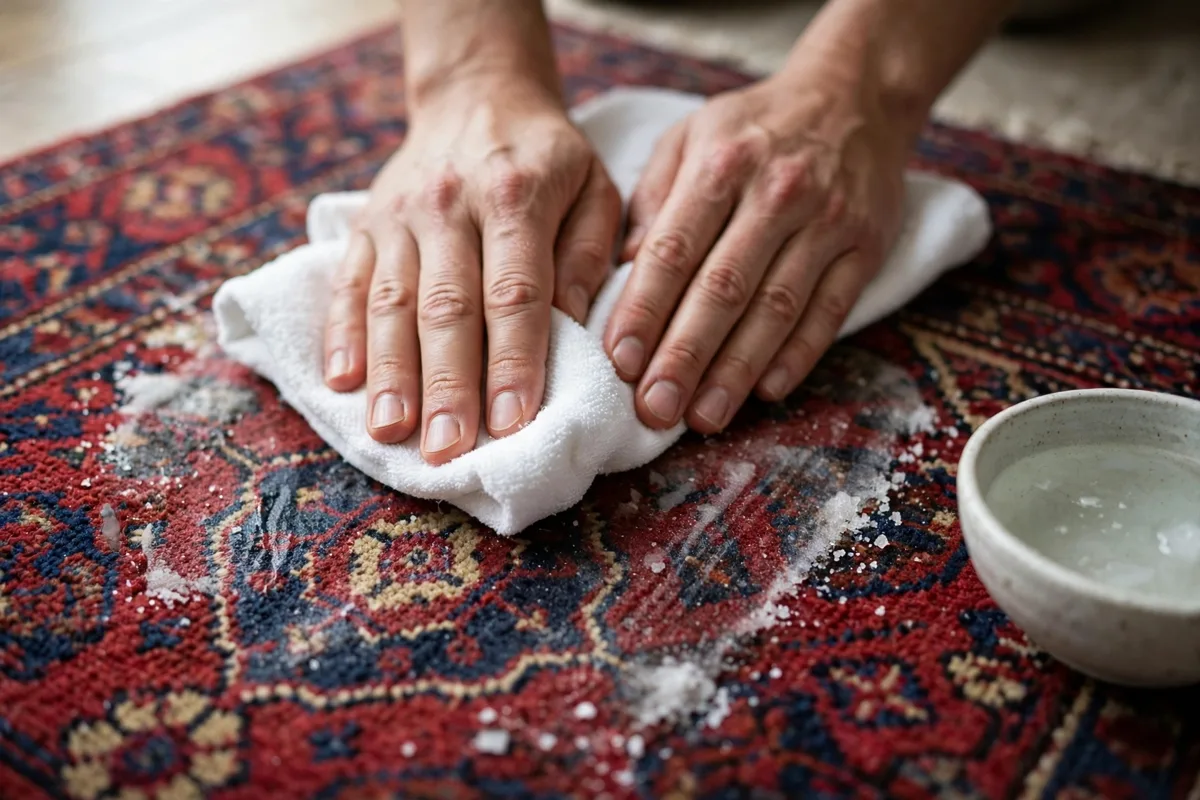
- Blot, never rub. Press a clean white towel into the spot to draw the meltwater up. Rubbing pushes salt deeper and frays the pile.
- Use cool water only, sparingly. A towel barely dampened with cool water lifts residue. Hot water and steam are hard on wool and natural dyes.
- Skip the carpet salt removers. Most are made for synthetic wall-to-wall carpet, not wool. If a white ring keeps coming back after the rug dries, the salt is in the foundation — that is a wash, not a stronger chemical.
- Dry it flat with moving air. A small fan is plenty. Never park a wet rug by a radiator or wood stove; heat makes fibers brittle.
When professional cleaning — or repair — is worth it
A professional wash is worth it when the signs point below the surface: white rings that return a day after vacuuming, pile that stays stiff, a sour or musty smell, or a rug that feels damp long after the weather dries. Salt in the foundation keeps cutting and keeps holding moisture all season, so waiting until spring costs more fiber than the wash saves. For timing guidance, see How Often Should an Oriental Rug Be Cleaned?.
Repair enters the picture at the edges. Fringe and binding take the worst of the grit-and-boot traffic, and once fringe wears through, the knots behind it start to go. That is exactly what rug repair in Keene is for — caught early, it is a small job; caught late, it is a restoration.
And if your entryway rug is simply past saving, there is a smarter play than a cheap synthetic: a hard-wearing hand-knotted runner takes salt season in stride and still looks like it belongs in the house. Browse the rugs for sale — and remember, there is never any sales tax in New Hampshire.
Common questions
Can I just shampoo the salt out at home? Surface shampooing usually drives the brine deeper and leaves soap residue that attracts more dirt. Blot and lift what you can; let a proper wash do the deep work.
Is it too late once the white ring appears? Rarely. A ring means salt is sitting in the pile and probably the foundation, but a professional wash can flush it out. The time to worry is when the pile itself has worn thin — prevention is cheaper than restoration.
What about pet-safe ice melt — is that easier on rugs? Pet-friendly melts are still salts, just usually a different blend, and they track in and dry into residue the same way. They are a good choice for paws, but the rug routine does not change: lift the crystals, blot the meltwater, and wipe paws at the door during the worst weeks.
Visit the showroom in Keene
Oriental Rug Works cleans, repairs, and sells hand-knotted oriental rugs at 109 Key Road in Keene, NH. Learn more about our oriental rug cleaning, area rug cleaning, and rug repair, or send us a message. We offer pickup in Keene (other arrangements can be made); call to set it up.
- Call: (603) 357-8400 or (603) 357-5152
- Email: orientalrugworks@gmail.com
- Visit: 109 Key Road, Keene, NH 03431 (get directions)
- Hours: Monday–Saturday 10 AM–6 PM, closed Sunday
Come see the collection in person. Every hand-knotted rug is tied knot by knot, so no two are ever exactly alike. Browse our rugs online first, then visit the showroom to see color, sheen, and craftsmanship that a screen can never fully show. Never any sales tax in New Hampshire! 🙌
---